Until my biking trip through West Bengal, I never discovered the little details –
the people and the places that make it beautiful.
Prologue
I was already one semester into my PhD, but it never felt like I was actually enrolled anywhere. With the Covid-19 hysteria waves finally receding, my campus was letting newly admitted people enter the campus in waves. I was not part of the first wave and ended up doing everything online for the first few months. In the second semester I finally got the chance to shift into campus. A rush of questions flooded me just before shifting to Bangalore – finally the whole PhD thing felt real, and was I really sure I wanted to do it at this point of my life, in this part of the world? I stepped out of the airport, and into a cool breeze. The way to IISc campus was long (Bangalore airport, by no stretch of imagination is in Bangalore), lined with dark green trees, bright red soil, and soft grey skies which sent down little raindrops almost in greeting, I laughed at myself for second guessing my decision ever.
My shifting in was not complete though, all my travel gear was back in Kolkata. Tanja and I had planned a trek and trip which would start from Kolkata. It was finally time for that trip.
Megha had been telling me to stay in Kolkata during Durga Puja. I have very little connections to Kolkata. A long time ago I had hatred for Kolkata, but I don’t now – I don’t have to stay in Kolkata forever anymore. But any city for me, holds some connection to me only through its people (my dogs make Kolkata’s case much stronger). Megha dedicates much of her dreams to leaving Kolkata, and paradoxically has probably the hardest time leaving the city. With an alarming disregard for her Telugu half and a disappointing acceptance of her Bengali spirit, she was telling me till the last day to not go on a trip during Durga puja. Unfortunately, I did not have any other holidays I could take, and Tanja’s visa would expire in December – this was the only possible time. Megha’s parents, in their entertaining from a distance but insanely frustrating in real life world views decided that Tanja and I were going for a “live-in”.
The trek had to be cancelled, as Tanja’s mother died on the day we were supposed to leave Kolkata, and she had to go home.
Megha’s wish had come true in the most twisted way, but she by now had made other plans. I sat down with her to understand her schedule – days that were blocked for her would be the days I’d get for a little trip. My bike hadn’t yet been shipped off to Bangalore, it would be a motorcycle trip this time. I’d have three days to explore as much of West Bengal as I could.
12 October 2021
I had decided to wake up early. I did, and slept off again. Several hours later, I packed my bag and finally started off. It was a bright morning, and the hallmark humid heat of Bengal couldn’t get its fingers on me as long as my wheels were turning.
The first hundred kilometers or so were familiar ground, I’ve been on that stretch many times. This time fortunately though, I was out to explore.
I stopped at a tea stall at Dhaniakhali. The shop owner got happy upon hearing how loose my travel plans were. A cyclist had stopped at this very shop the day before. He had a year to use and India to explore. The shopkeeper had a pump and he had used it to make a shower for the cyclist. I proudly told him I’m a cycling enthusiast, who just happens to be on a motorbike currently.
The shop owner was also a factory worker – they worked with Cashews. It’s generally his brother who runs the stall, but he was taking a Puja vacation of sorts. Cashews come in from South Africa. Here they are boiled and packed. Most of it is bought by major biscuit companies. Some packets are sent off to places in northeastern India. The stall owner told me with a hint of pride that he had gone to school and learnt to read a little bit, and that’s how, from little labels he learnt about the geography of the cashew operations. Some packets made it as far as Nagaland. Junctions of the global trade/transport chain can turn up anywhere if the wages are low. I was only 50 kilometers away from Kolkata, naïvely thinking just the stretches of green fields could shield some place from clutches of the global economy.
The more towards Burdwan I went, the more acceptable it became for Lungi to be socially approved Puja-wear.
The highway was lined with lush green bushes, freshly recharged after the monsoon, speckled with yellow, purple, and white flowers. The curb couldn’t curb them in, they spilled joyfully over onto the pavement.
I crossed Burdwan and entered a quieter state highway. I saw a bamboo – and – tarp restaurant, it had empty cots laid out in the shade – I had to stop. There was a little stretch of empty land behind the restaurant, this was advertised as the parking space on a banner. Bike seats get very warm very fast, so I ignored the parking space, and parked right under the roof of the restaurant. I lied down and stretched on one of the cots until a family arrived in an SUV. Somebody told me “Paaji you have to get up now”. I was happy enough to be mistaken for a Punjabi, so I wasn’t sad about having to get up.
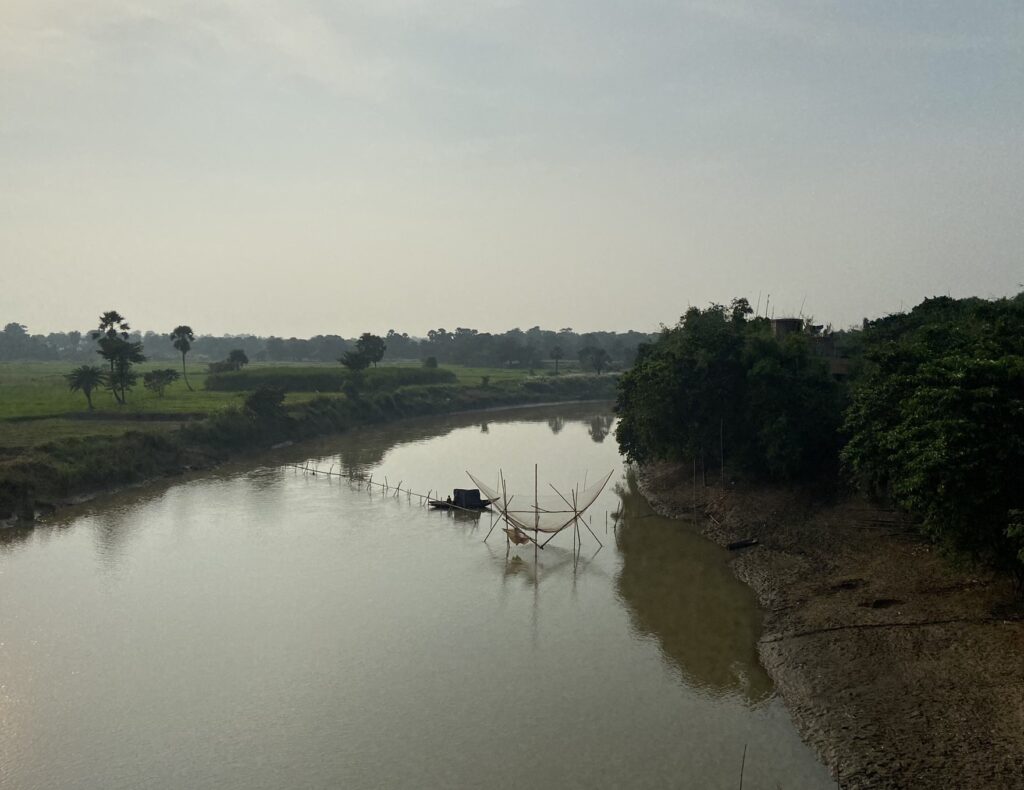
Deep green fields were broken with dark ponds, and sometimes with rivers a few feet wide, more rolling in the arms of the landscape than carving their way through.
When I started out the skies were dull, they had a big city kind of grey holding back the blue. The further I went, the bluer they became. Under those blue skies, I was going through a little two-lane road, lined by enthusiastically green eucalyptus trees. The wind came rushing through, and there I was, in a rainfall of little yellow leaves.
The narrow road had led me into Birbhum, and it was afternoon. Almost every shop was closed. In Nanoor I finally found a tea stall that was open, but the shopkeeper was asleep. I woke him up, and he assured tea would be available. He told me just a few hours ago a few bikers had passed, heading towards Siliguri. The road was way too small to be connecting two huge cities like Kolkata and Siliguri. Google maps rewards those foolish enough to trust it quite appropriately. I had no interest in taking either the fastest route, or the shortest one to anywhere, I was out to explore. I was happy to follow any road.
The shopkeeper told me he used to work in Bangalore, as a driver. It was a nice company, and his boss had paid for his daughter’s education. Sometimes he would be upset, threaten to leave, but his boss would wait for his return. His return would be mostly in a few hours, sometimes though, it took as long as the next day. In any case, he left on good terms, and came home to take care of his parents, and when they passed, their land. Now he has people working on his farm and understands the challenges of keeping a workforce happy. It was puja time, so get togethers with friends were planned. He was getting some sleep during the daytime, the get together was at night. One of his friends was in Kolkata police, he would be bringing confiscated/ controlled material. He proudly told me he was a Muslim, but all the friends joining him that night were Hindu, and they happily shared festivals and food. Artificial boundaries that keep people apart take too much away from life. I couldn’t agree with him more.
The road soon turned into potholes, and I puttered along. Murshidabad starts at Majlishpur. A very Bengali tradition is to have two names for people. One is official and the other one’s just a nickname that every non-Bengali finds absurd and meaningless. This village also had two names; locals called it law-gram.
I had seen a shop which advertised Lassi. I stopped there, and found out not just Lassi, but all curd related items were off the menu. The unavailability did not stretch till milk though, tea could be made. I was hungry too, it was afternoon already, and the potholes had drained me quite a bit. There was a kid playing around, he was the star of the shop. Everyone hanging out at the shop insisted I take a photo of him. The kid definitely loved posing.
The explosion of potholes ended at Khargram. I stopped at “Nayan-da’s” coffee house. It was built like any other roadside tea stall, but it was clearly run by a visionary. Cafés in cities advertise themselves all over the place, and you pay for the advertisements, ambience, experience, and the cheapest part in the bill is edibles. Nayan-da had only a little shop in a village by a narrow road, but clear café dreams. His advertising was on posters plastered on his shop, and in some other places around. These posters were made of the same material as movie posters, and had quite a similar aesthetic. The movie’s name was Nayan-da’s Pecial Cha (who says fine food has to be French, and only French can have silent letters? I admired Nayan-da’s decision to stick with his dialect). The rest of the poster depicted the stars of the show. There were a few pictures of Nayan-da himself, in highly reflective blue sunglasses (heroes must wear shades), the rest of the poster was dedicated to his costars – tea and coffee in various arrangements. Along with this, there were pictures of Nayan-da with various celebrities (mostly politicians). These pictures were more valuable, so they had been laminated before being hung up. The ruling government party had campaigned in the last election with the slogan “Khela hobe” (game on), Nayan da had posters up with “come here we’ll play”.
I washed my face from a water tank Nayan-da had kindly installed for weary travelers and had his special tea. It was as cheap as anywhere else, but it was indeed special.
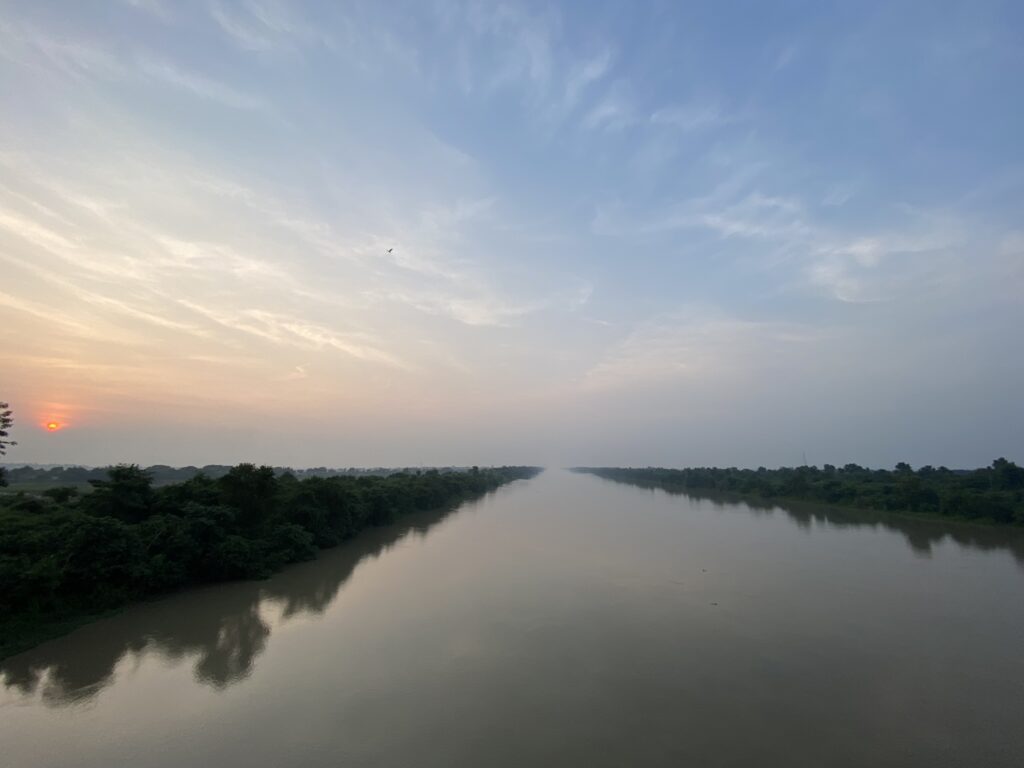
The road I was on joined with the large highway at Sagardighi. It was evening already. I was on my way towards Farakka barrage. At a tea stall I learnt that this side of the river, Murshidbad, controls 10 – 20 gates, the other side, Malda has the rest 100 – 90 (these numbers are hard to keep track of, gates keep getting dysfunctional).
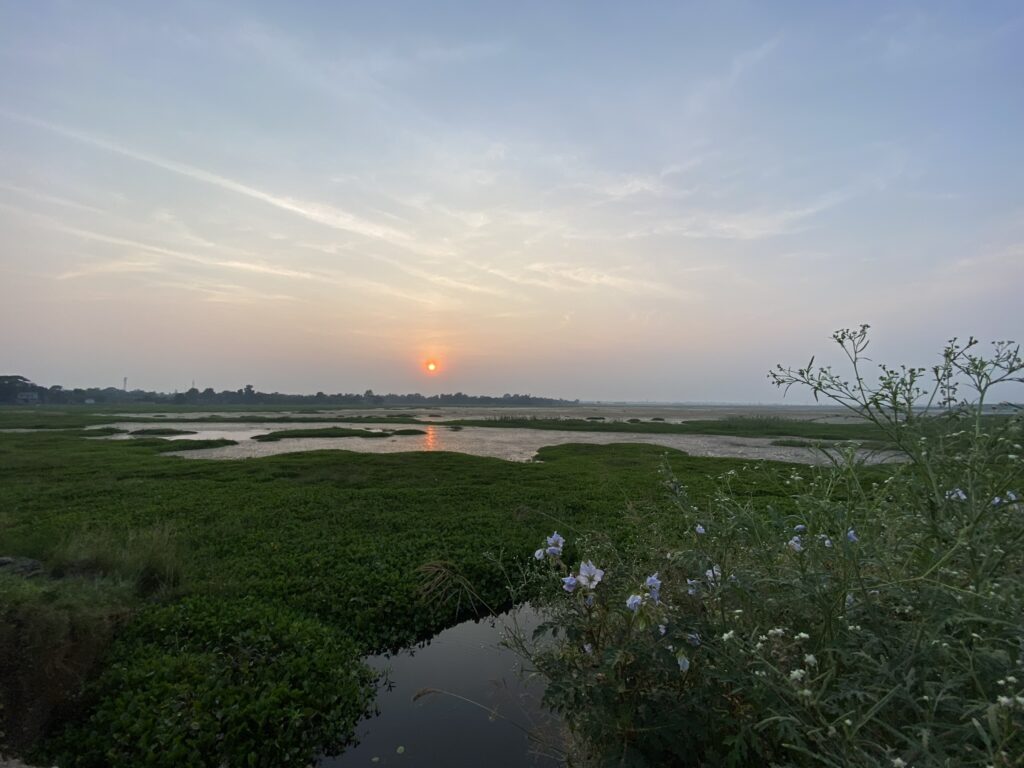
I stopped by a vast stretch of wetlands at Suti. Patches of still water and patches of green stretched out till the horizon. Birds flocked overhead in the clear sunset sky. Little blue-white flowers looked up. I stood there to watch the sun go down. Cars on the highway blasted past the lazy landscape, ignoring the no horn zone signs. The signs also stated that this was a bird sanctuary. We humans have an incredible power to ignore beauty even when its staring at us right in the face. Adding signs of course doesn’t help.
Mahadeb-Nagar was my last stop while there was still some trace of sunlight. When I stopped, the sky was a shade of purple that’s almost black. I sat and watched the sky turn as dark as the asphalt below.
I reached the huge barrage in darkness. Little orange lights on the shore stitched together the sky and the river. Soon enough, the shore faded away into the distance. Only the barrage road had streetlights. All around, everything else was dark.
I passed through Malda over the next few hours and entered Raiganj. Raigang is the district headquarters of Uttar Dinajpur, and had an accordingly large puja celebration and traffic jams. The traffic jam ensured that I look at the people around closely, and I realized I could see traces of the “mountain people features”. This town was well in the plains, it behaved like it was in the plains, the mountains still far away had just started to be apparent in people’s features, people who were, in all other aspects, from the plains. Traffic cops showed me shortcuts and police approved wrong ways. I stopped at a truck lay-by just outside town. One truck was coming from Rajasthan, going towards the Kolkata port. Another was going towards Siliguri, from the port. One of the younger people told me he does bike trips with friends when he does not have transport work. An older man and I bitched about private cars (especially SUVs) and bonded. He told me truck drivers always try to save living creatures, even snakes, but private cars themselves make it quite difficult to save them. He told me bikers can also be like that, I assured him I was not one of those bikers, and he took my word for it.
By then, there was so much dust on my visor, light was coming in with various special effects. Though psychedelic, it was not an experience I wanted to continue. I wiped everything down with wet wipes, and the insides of my helmet smelled like an airplane. In my new airplane, I flew into the night.
I reached Karandighi, and finally decided to call it a night. At a truck stop restaurant, I stopped for dinner. There were cots spread out, so I asked whether I could stay there for the night. It turned out that the cots were reserved for the restaurant workers. Additionally, there were thieves around (who did not pose any threat to the restaurant staff), so I was told to go four more kilometers down the road, and stay at a Hotel.
Incense from Puja pandals came riding on rolls of smoke and filled up the highway. I finally stopped at the recommended hotel, and got a room for 500 rupees for the night.
My room was unlike any place I had stayed in before. The room was mostly the bed. There was a thin strip of land that was free of bed, just enough to let the door be opened. Some places have attached bathrooms. What I had was attached bathroom lights. The bathroom was at the end of a common corridor, but the light switch was inside the room. The windows opened into another corridor. I’m not sure whether it was by accident or by design, the windows were reflective on the inside.
I had a scarf, which I turned into a pant/skirt, and slept off happily, in my king of king beds.
13 October 2021
I woke up, and realized the only form of soap I had with me was toothpaste. I bathed with toothpaste (it’s actually more refreshing than any shower gel or soap ever produced) and dried off with the scarf that had been a pant until then.
The ground floor of the hotel was a restaurant. Restaurant–cum–hotel staff lived on the first floor. To uphold hierarchy, The second floor was reserved for guests and the manager. I woke the manager up; he had locked everyone in for the night.
Siliguri was close, but I was too close to Naxalbari to not pay a visit. I had to see for myself the town that has inspired so many people over decades. The peasant uprising may not have captured the power it had intended to, but it still keeps capturing people’s imaginations. When the government attacks its own people for land, for forests, for minerals, and people take up arms, it’s an inconvenience, but governments understand. They send guns to do the talking. A dead population generally agrees with government policy. It’s a different matter when people in cities, properly civilized, educated and all, speak against the government. Government approved participation in politics has strictly two categories: either be a voter and nothing else, or join the ruling party’s lynch mob. The government’s irk at being challenged by citizens is embodied in the cuss word they made: Urban-Naxal.
The road to Naxalbari goes through Bihar. Bihar was dramatically evident. Everything was brighter. Sarees were more colorful and bright, jewelry was shiny, and even the skies seemed cleaner. A narrow road winding through (bright)-green farmlands finally took me to my destination.
Naxalbari turned out to be as chaotic and as peaceful as any other small town. Puja was going on in several pandals. A colorful crowd ambled through the narrow streets made narrower by markets. Mountains in the distant north made a soft backdrop. Trees brushed against the rest of the sky. I asked for stories from the town’s past at a tea stall. With a smile, the owner (a native of the place) told me that being an educated kid from Kolkata, I’d probably know much more about the stories I was asking for than him.
As I left, I couldn’t help but admire the people who had organized the revolution that had started in this peaceful quiet foothill town. Perhaps, the greatest leaders are the ones who can get people who only accepted and adjusted in the past, to change the present, and become inspiration for the future.
I reached Siliguri in the afternoon. I called my cousin who lives in Siliguri to tell him I’ll arrive at his place in the night. I still had half of the day left, and the mountains were waiting. I had decided I will go towards Darjeeling. I had no intentions to reach Darjeeling, an even if I did, I would turn back and come down. Darjeeling is a staple destination of Bengali tourists. A hill station which has traffic jams cannot be counted as a hill station.
The day was Ashtami – and everyone from Siliguri with a bike or a scooter had decided to take Durga puja up to the mountains. The road was teeming with two wheelers, driven by men in kurtas and shades (as I have said before, heroes must wear shades). All the women sitting behind wore sarees and heels. Information about where to wear the helmet and where to wear the mask kept being exchanged from two-wheeler to two-wheeler, as required by traffic police.
I stopped at a restaurant for lunch. I had chicken Momo while a chicken played around in the sitting area. The restaurant had no walls, and an amazing view of the mountain slopes.
My road ran alongside the toy-train track, and they kept crisscrossing each other. At one town, the train was at the station. The tracks came out from the station, crossed the road, and continued on the other side. I crossed the tracks and stopped to take pictures. A SUV came up, just as the train was starting out from the station. Through the windshield, I saw the SUV driver look at the running train like it was a challenge. With his car, he proceeded to get on to the tracks, block the train’s way, and win the race against the train. At that moment, I found a new life goal. I want to be a toy train/ tram driver. Even if my job lasts one day, I want that day to count. I want to remove as many SUVs from the road as possible.
I stopped at a tea stall run by a woman about my age. She was married. Her husband and in-laws lived down in Siliguri. I asked how come she was up here. She said plains are a nightmare. Her husband who lives in that nightmare keeps coming up to the mountains to meet the girl of his dreams. She was happy with that arrangement, there was no way she would live in the hot crowded plains. I told her very enthusiastically how much I agreed with her.
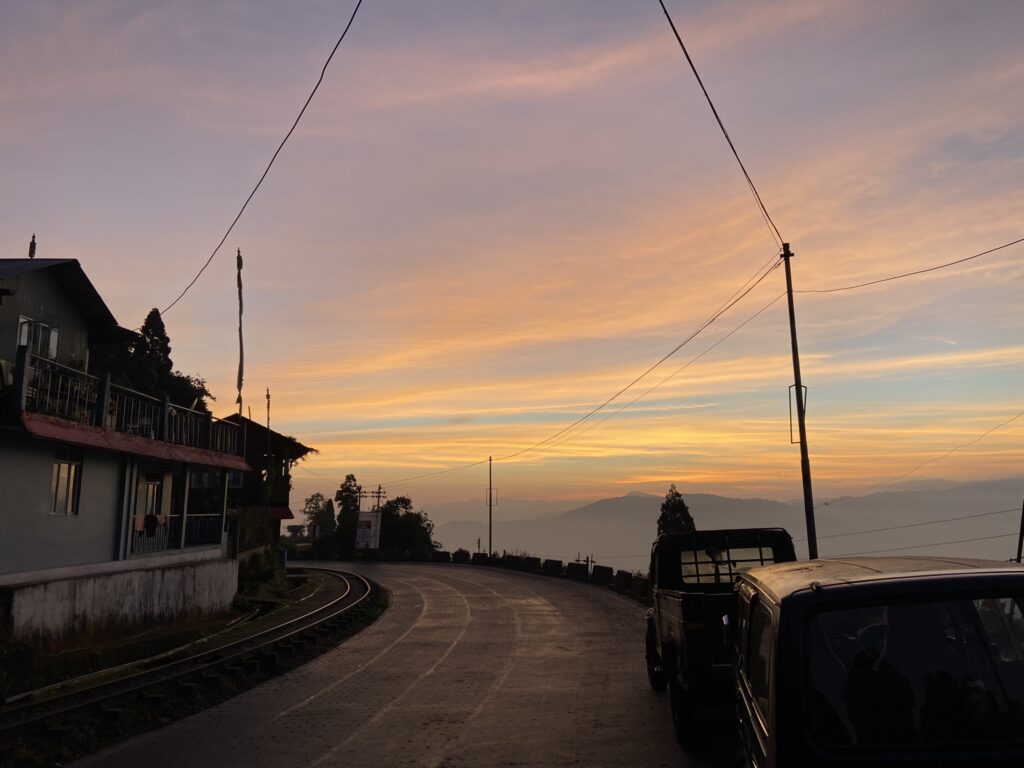
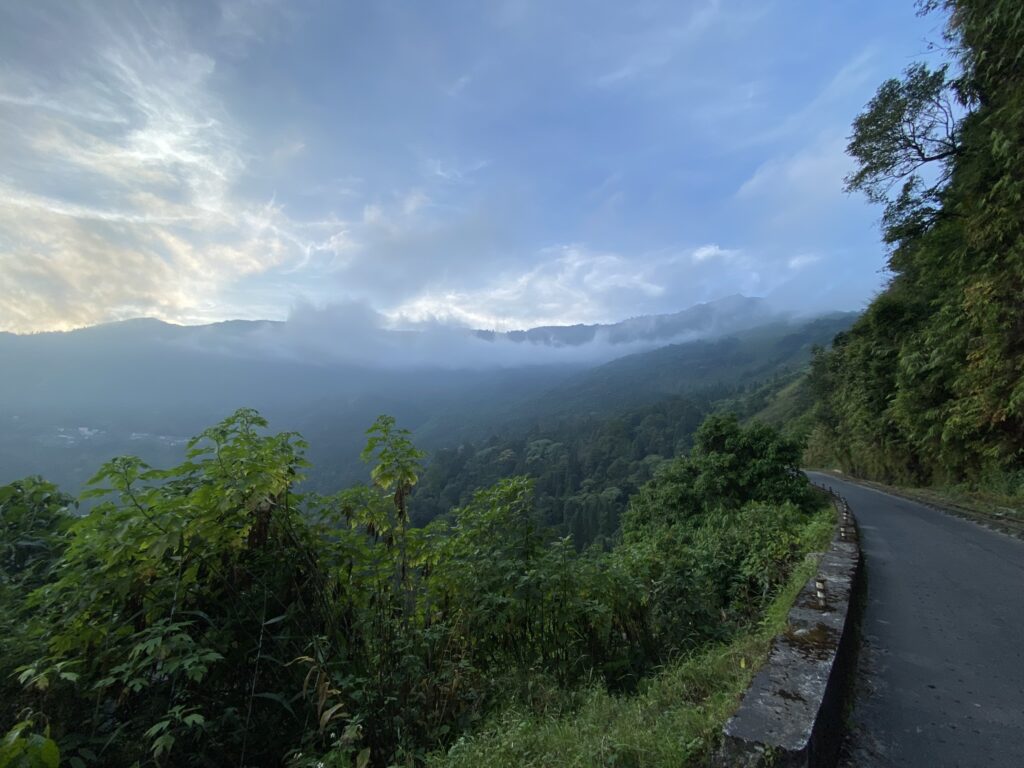
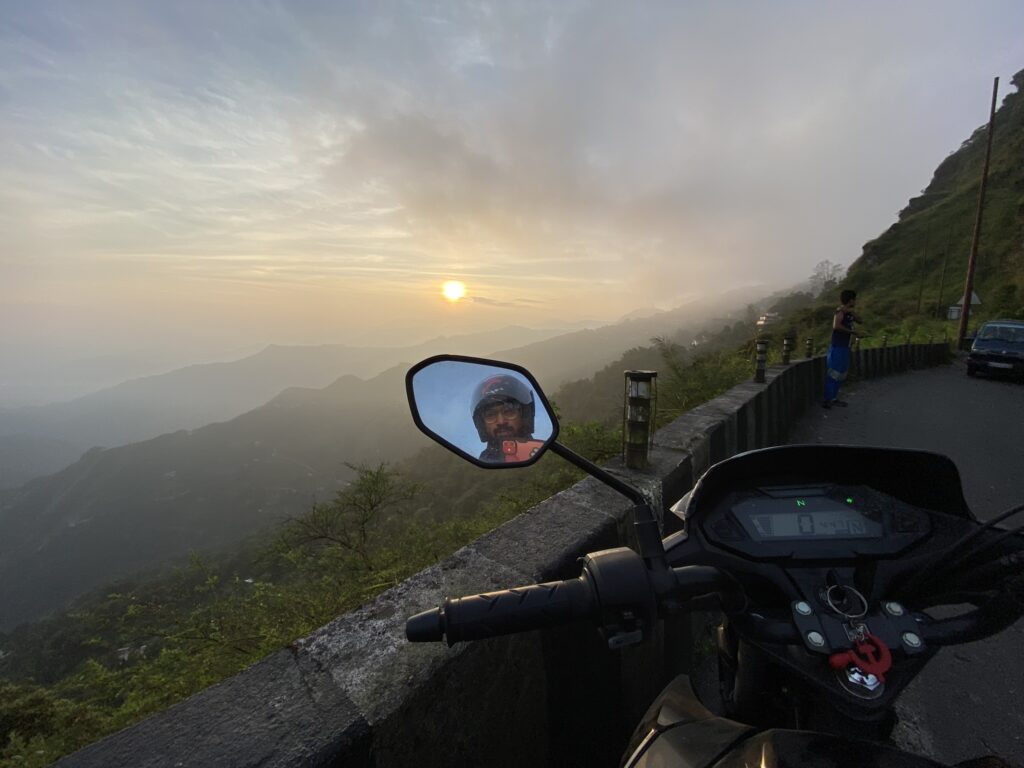
I climbed higher and higher as the sun went lower and lower. The clouds lit up. The mist around me glowed golden and stroked the valleys bellow. The waves of evening colors and the streamers of clouds were all passersby like me, rolling through the dark soft monsoon green slopes of the mountain.
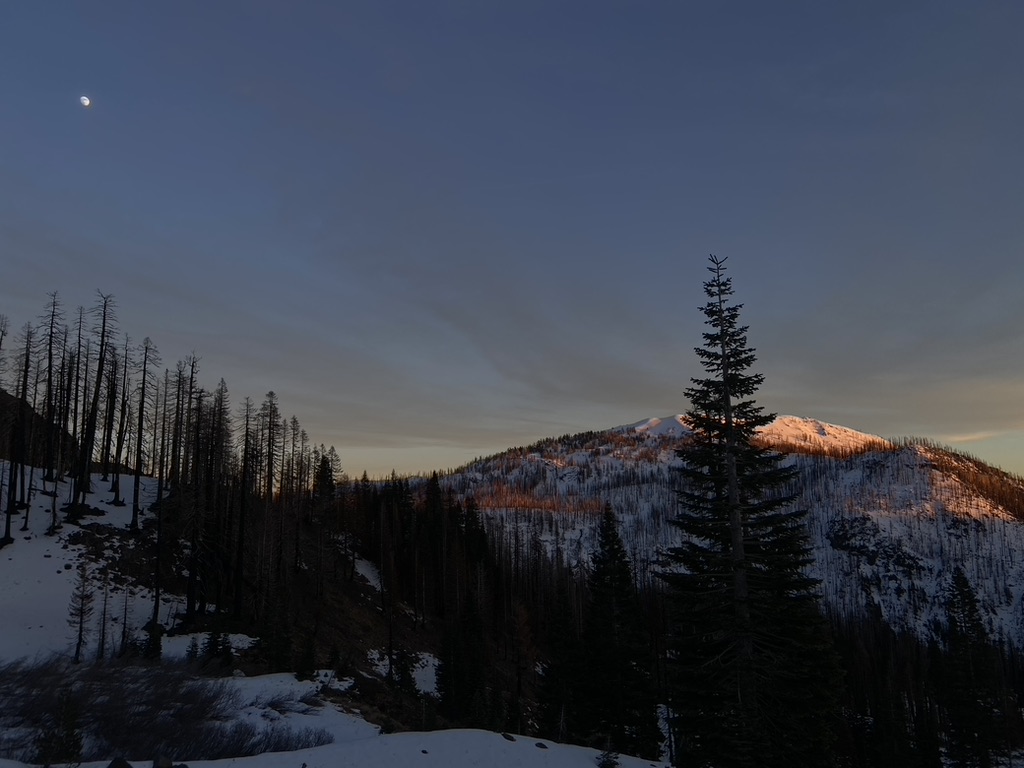
I stopped to greet the night that was rolling up from below, and seeping out from the valley walls. I waited as long as the distant valleys held on to traces of the disappearing dusk, while the moon started to stream down over my dark mountains.
I had to explore more of the night, more of the mountains. I stopped at a little stall. I sat on the curb to stretch out my legs. The owner was middle aged man with long hair. He asked me whether I’m being paid to go around. I said no. Relieved, he told me influencers are a pain in the ass. They come in droves, and fill the air with buzzing drones. But they at least made his business flourish.
I went on till Sonada. I had to turn back, my place for the night was fixed. Before coming back though, I learned a few words of Nepalese from a family hanging out at the road-ward side of their home, which was a grocery store.
As I came down the slopes, the cold wind rushed on to my face. I could have closed my helmet visor. But I couldn’t afford to miss out on any part of the place I was going through.
The road was now empty, except for an occasional bunch of people blasting off towards Darjeeling.
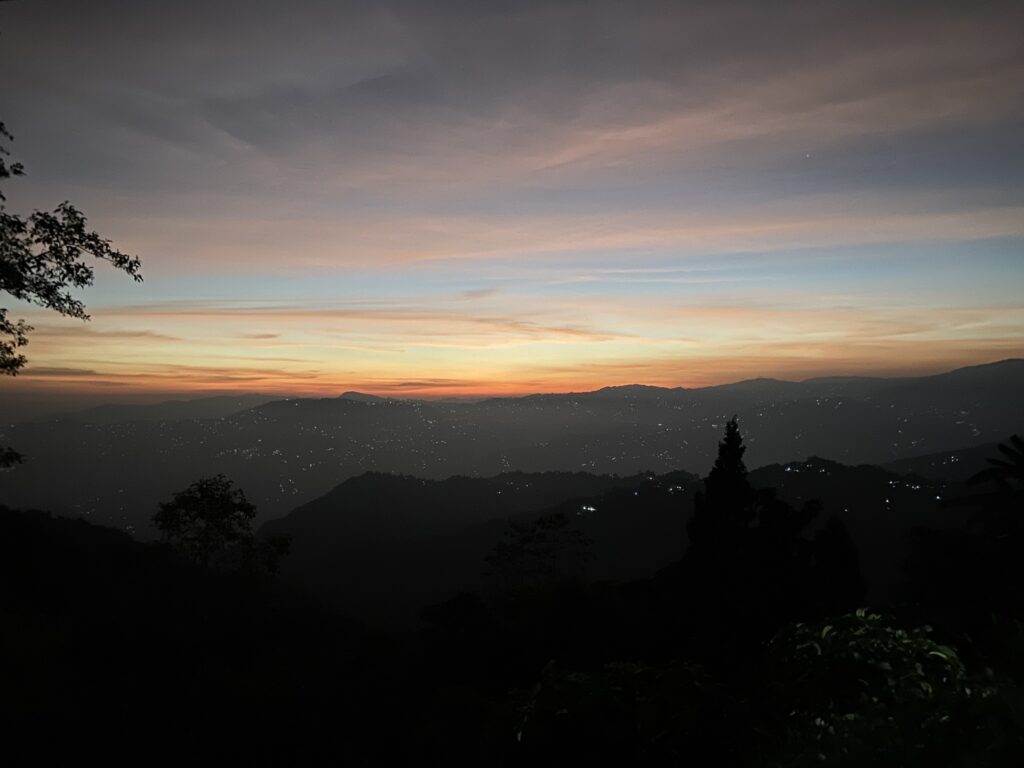
I wanted to stop. I wanted to hear the night, smell it, feel it. I wanted to see the darkness without cutting it up with my headlights, to hear the rush of streams without the putter of my engine. I considered whether it’d be safe – elephants and big cats could be around. And then I realized my immense stupidity. I was even thinking about whether to stop or not just because I had a bike. I wouldn’t really have tried to judge between stopping or not had I been on a cycle. And here I was, pretending to be responsible, by having my thoughts muddled by an illusion of safety. Speed is an addiction. So is passing off excuses as being responsible or safe. I’d have to be careful to avoid both. A few bends of the road cleared my head up.
I stopped at a waterfall. I parked my bike by the mountain walls, and climbed up in the darkness to sit beside the waterfall. The waterfall was pouring out from the star speckled sky. The dancing waters carried runaway moonbeams in their embrace. Together they lit up the way to their heaven in the valley far below. I sat there for a long time.
The first human settlement as you enter the plains is at Sukna, around a few army camps. The was one puja pandal. There was one group of people, and one policeman. They shared the same spirit, and were taking stock of the spirits gathered for the night.
When you travel in a forest, your senses get hyper-tuned. I reached Siliguri, and the first thing that hit me was smell of shampoo. It was Ashtami indeed. Girls had their hair either down, or flying (Siliguri has an unspoken law about helmets being not required during Durga puja).
I reached my cousin’s place through a colorful, cheerful, dressed in their best, moving slowly and enjoying the slow movement of the crowd.
14 October 2021
A bright sunny morning coaxed me out of Siliguri to start the homeward journey. I was coasting through waves of dark green tea gardens. They were painted with shadows of the larger trees in the gardens. I didn’t see any predatory animals, but I did see Nuns in blue gowns roaming around.
Uttar-Dinajpur makes it clear that you’re out of the mountains. It gives you a black road stretching on and on through green fields. I stopped at a mosque for water, bright little flags covered the whole courtyard, and turned the quiet blue sky into a festival of colors.
It was afternoon, and I was on a stretch of road under construction. Half of the road was open, but it was littered with gravel. A SUV was coming up behind me, and by now I was experienced enough to know my safety was proportional to my distance from SUVs. I tried to get away from it, and in my panic forgot all about the gravel, and a prompt skid quickly brought me in close contact with them. One truck came in front of me and stopped. Another came up from behind, and together these two monstrous vehicles blocked the entire road until I could get up and move my bike off the road. No one could pass and run me over. Not even SUVs. The truck drivers made sure I was getting the help I required before moving on. I got help from a tractor driver who was parked on the divider. He told me to take water from him and wash my wounds. I thought I was going to get a water bottle or something. He told me he had a lot of water in the tanker attached to his tractor, I should just turn on the tap, and wash to my hearts content. I did, got back on my bike, and quickly realized that the wound on my palm was serious enough to not be satisfied by just water and a piece of cloth tied around it. There was a tea stall, I went in there to ask for more water. There were around ten kids there, who made it their duty to not let me buy something that is free. I got invited into their home right behind the shop, to use their tube-well. After cleaning up with water, I put sanitizer on my cuts (my reactions to this searing sanitization were probably the most entertaining bit for my care givers), bandaged them up again, and started off. The rest of the journey was slow, anything more than slight vibrations from the handlebars was enough to make me wince.
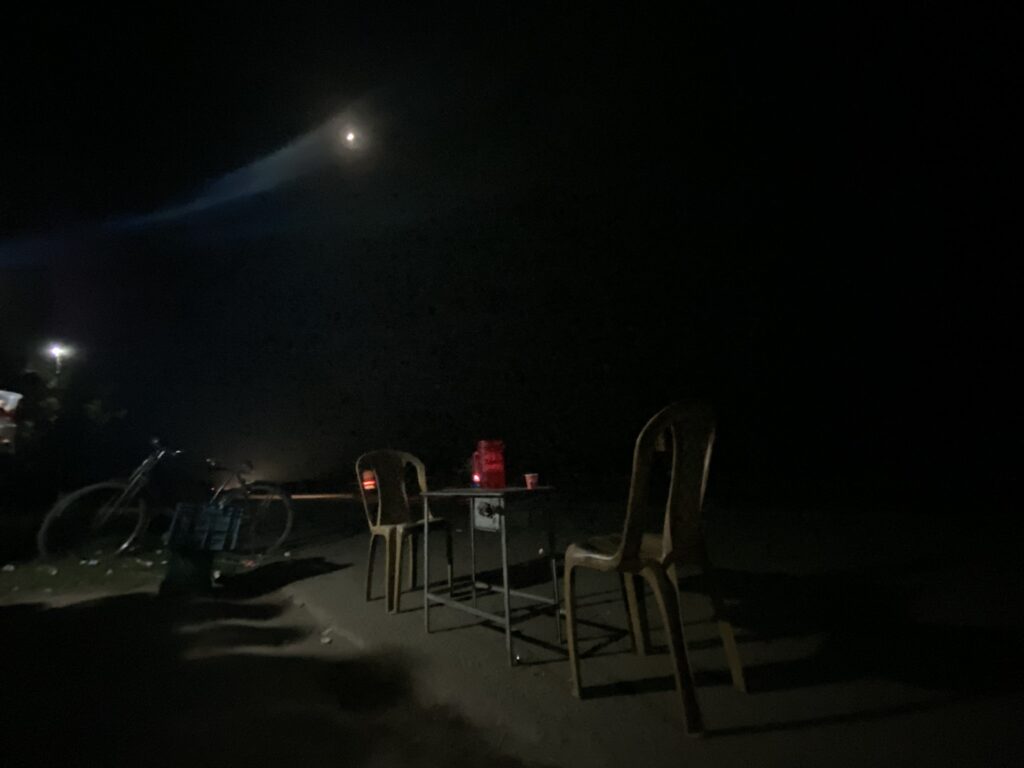
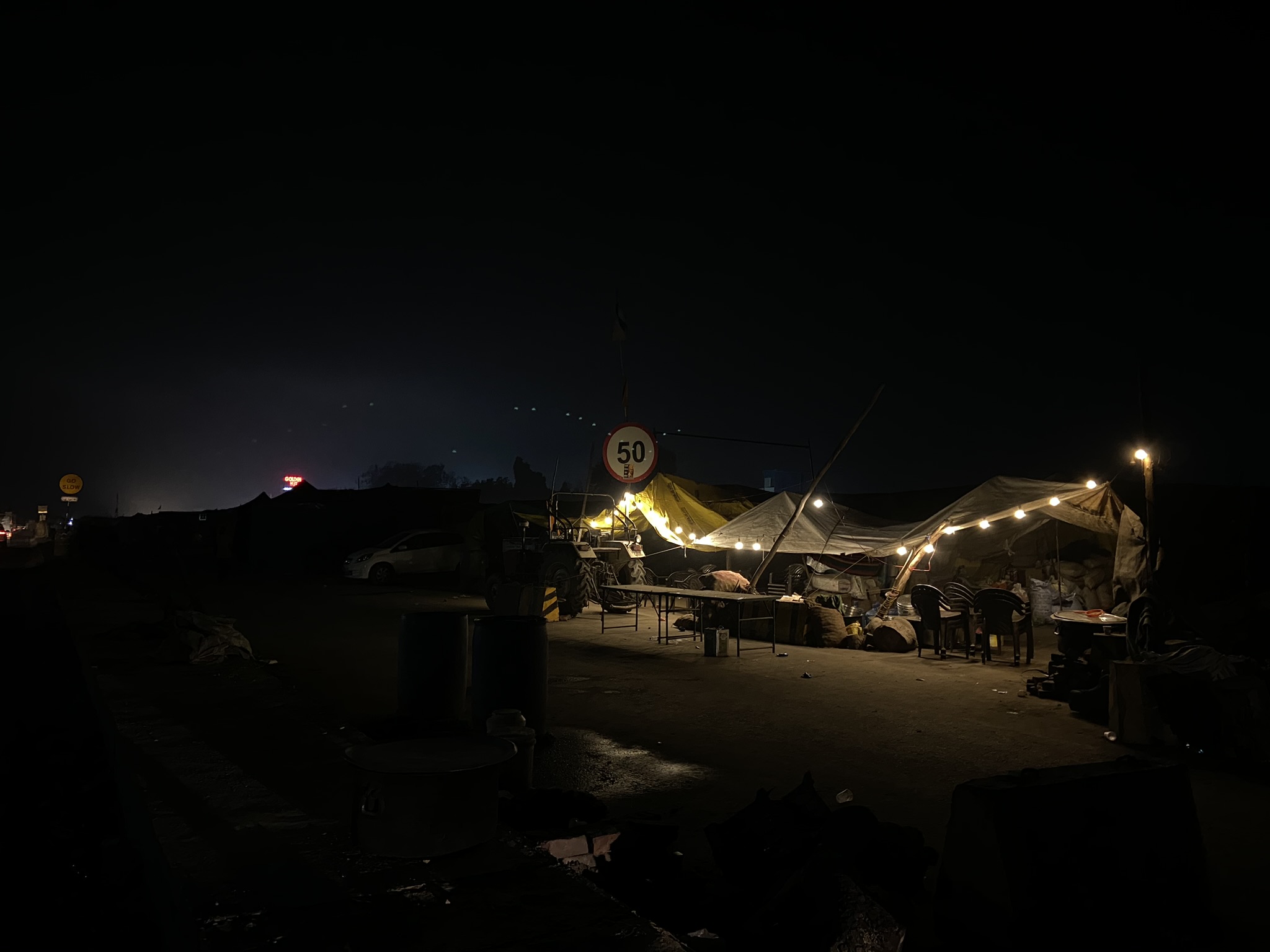
The evening came in shades of orange, pink, and violet. By the time I reached Farakka, it was dark again. There was tea stall with a single table laid out beside the empty black highway. Two chairs sat and two ends of it, under a white moon. Sure, the empty chair would haunt me, but I had to sit down. The owner joined me. He asked me what I did for a living. I told him I was doing my Ph.D. This meant nothing, so I explained what I was actually working on. It was one of the toughest exams I have ever faced. I had explain my work without hiding behind a single technical, or even popular science term. Climate change and pollution, it turns out are easy to explain. Everyone faces some aspect of it. For him it was irregular rainfall and harsher summers. You just have to not be dumb enough to deny what you see and feel happening around you. He concluded that I am a scientist. Scientists, he knew, knew a lot. He had some court case going on, about some pieces of land. He wanted me to take a look at the legal documents. I did. Then I explained to him that legal documents are designed to be difficult to understand. The law may claim to be for the people, but legal documents are written strictly to be for the lawyers. This intentional overcomplication has always irritated me. Why does everyone in the legal professions pretend to be Shakespeare? What harm did simple sentences ever do to them? Anyway, I explained the documents the best I could (do lawyers hate each other so much that they want to give each other headaches?) and left. He told me to work hard and stop climate change.
I reached Berhampur. I was in the middle of Durga Puja again. Bikers and traffic police have a reputation for being enemies. I went up to a traffic police officer to ask for directions. While my map offered me several options, only a traffic cop would know actually how congested the routes were, and which one would be generally nicer. He gave me the routes, and then told me he would rather chat a bit than say bye. Afterall, I had come a long way. But he would understand if I thought I still had a long way to go, and wanted to keep moving. It’s true I had a long way to go, but what are roads without stories, what are towns without people… He turned out to be a history enthusiast. I used to hate history in school, but after becoming interested in politics, history has also become interesting. His history was not as strong as his interest in it. He was under the impression India still pays taxes to the queen of England; India was still not independent. I told him I agree that India is still not independent, but gave him other reasons to back up that claim. His eldest daughter was in school and was a consistent class topper. She wanted to become a doctor. He was very concerned about that. I was surprised. Most parents I have come across try to force the medical (or engineering) profession into the dreams of their children. Here was a person who was worried because his daughter wanted to become a doctor. He explained, he had calculated the fees. After class ten, she would have to take up science. Science fees are higher. Then, private medical colleges are obviously out of the question (go to a doctor to sell your organs, to pay for becoming a doctor). At this point I interjected; government colleges were at least not this money thirsty. He told me I’m right, but to get into a government medical college is also difficult. She’d have to take extra coaching classes. Those are another huge expense. I couldn’t disagree. The entrance exams have become distorted enough to make coaching classes almost a necessity. Coaching classes are a huge industry, an industry intricately intertwined with the education system. This wedlock ensures that on one side the education system will not teach well enough, and on the other side the entrance exams will not really be based entirely on the school syllabus. I did give a few entrance exams without coaching classes and got lucky. What do you do when you can’t afford to count on miracles, but can’t afford to go through the system either? The state knows about this problem very well. Instead of cracking down on the coaching mafia, in the New Education Policy the biggest coaching companies were given a new advantage, in the form of digital education being made an acceptable part of formal education. It’s weird how clearly the state only wants rich kids to take up higher education, especially in science. The New Education Policy takes this further quite elegantly, by introducing vocational courses. It looks like more choice, more fields and disciplines and learning intensity to choose from. Behind that screen of choice, it screens lower income people into lower income vocations, and higher income people to keep pursuing disciplines leading to higher income. The traffic cop didn’t have only one daughter, he really had a tough battle ahead, just like his daughter. I wished them well. He had ignored operating the traffic light to talk to me, traffic had started to build up. He gave me a pan-shop treat, I went off on my way, he went off to release the pent-up traffic.
Crossing Berhampur proved to be quite tiring. I saw a hotel for Biriyani. I asked if there was a place to stay. There was. It was under construction, but when your plans are always under construction you can’t really expect your sleeping spots to be traditionally perfect. Good thing is, for me being able to fully stretch out under a roof is pretty close to perfect and being able to lock the door is luxury. The Biriyani was amazing, and so was the curry that came with it. This was the land of beef. The hotel owner told me I could easily think of this place as a little piece of Pakistan. I asked why, he said it’s because they can freely cut up, display, and eat beef. I said you could also call it a little piece of Bangladesh, its right across the border to the east. He laughed and said Pakistan just sounds more exotic. I met a few local people who after a late puja excursion came for the Biriyani. One of them had a special interest in bike trips. Ironically, he can’t go on trips because he runs his own travel agency, and leaves are hard to get when you run your own business. He also has a transport business. He explained the tax, fine, and bribe shenanigans. The police, controlled by BJP were taking bribes for overloading trucks. Legislators from TMC came into power and increased the load limit for trucks. Now the roads are more broken, but so are the BJP officials, after all, you can’t charge bribes for overloading if the trucks are not legally overloaded. He was a congress guy, happy that two greater powers were keeping each other balanced out.
15 October 2021
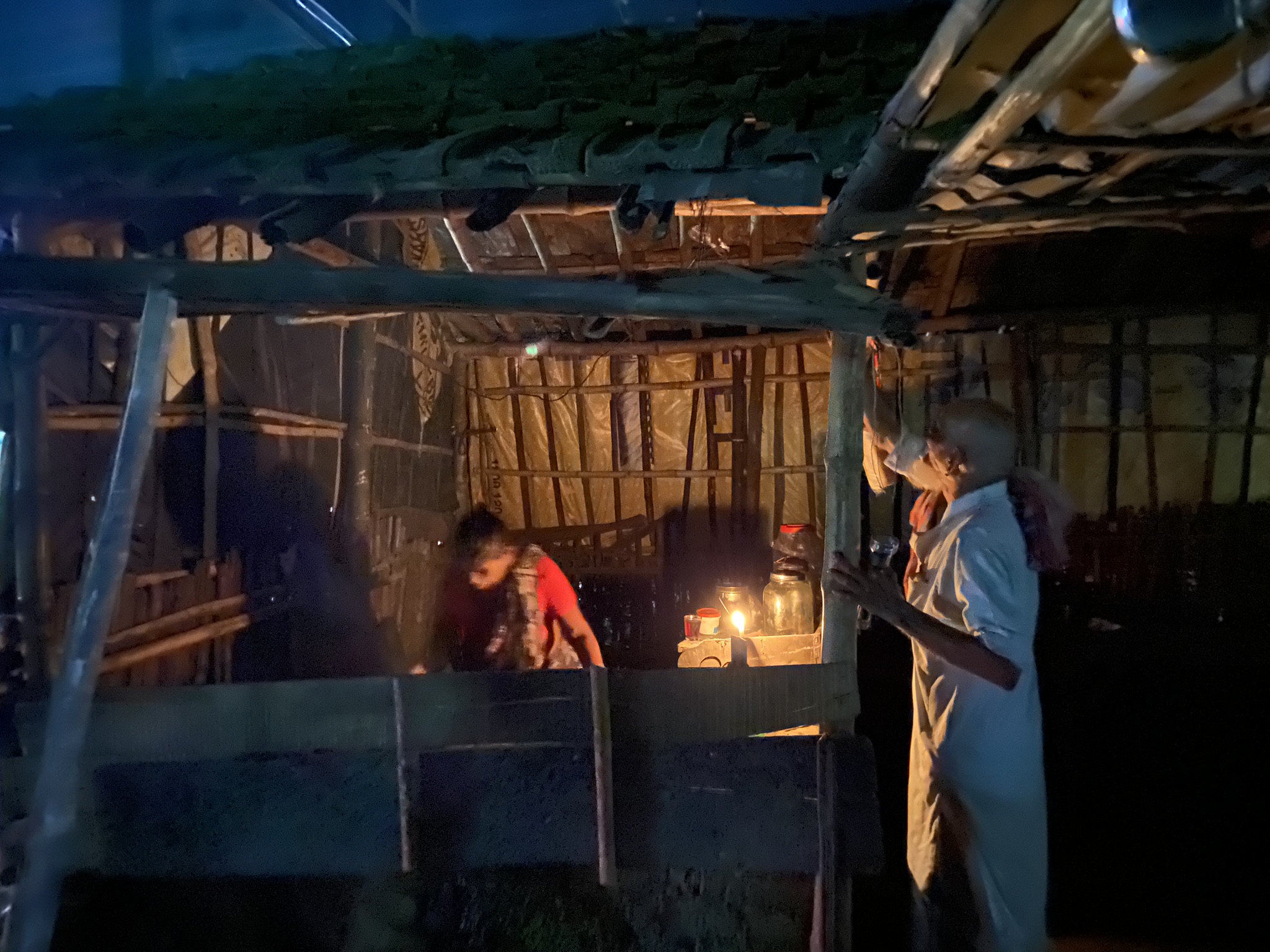
I was close to home, but detours are an integral part of any route. Through deep green fields I made my way towards Burdwan. Dolan, an old friend was home to celebrate Durga Puja. This was the closing day of Durga Puja, everything was closed. A guy at a tea stall got into an intense monologue while making tea. He concluded that our purpose on earth is to do God’s work. God’s work is to spread love. Right now I’m doing God’s work because I’m listening to his stories and he’s happy just because someone is paying attention, listening to him ramble.
I believe neither in God nor in doing God’s work. But I think people have a lot of stories to tell. It only takes making people a little bit comfortable, to get them to share stories. And what would any journey be, without shared stories?
Epilogue
I had never really realized how many dialects Bangla has. I used to believe the answer is six, as learnt in school. That was a lie, like many other things.
They have a strange way of teaching geography in school. You’re supposed to memorize a bunch of place names and facts about those places. Why those places? Because someone decided they are encircled by an imaginary line, which specifies which places you’re supposed to care about. I couldn’t care less about geography. You can only fall in love with stories, not facts. For the first time the state I lived in became more than a map, more than pages and pages of information. Finally, after all these years, West Bengal became a story to me.
I realized how naturally people stay together. Harmony is an intrinsic desire. It takes huge motives, huge lies, huge campaigns to get a bunch of people ready to attack some “other” group. Today in the middle of such a campaign, the easygoing approach I saw to artificial divides gave me both solace and inspiration – it’s something worth fighting for to save, it’s something worth fighting for to spread.
Tanja’s brief experience of Kolkata is here: https://www.tanjaluchsinger.com/podcast/38-arriving-and-leaving